Infowelat Enformasyon Ji Bo Welat
Gotarên Têkildar
📌 Bi kurtî
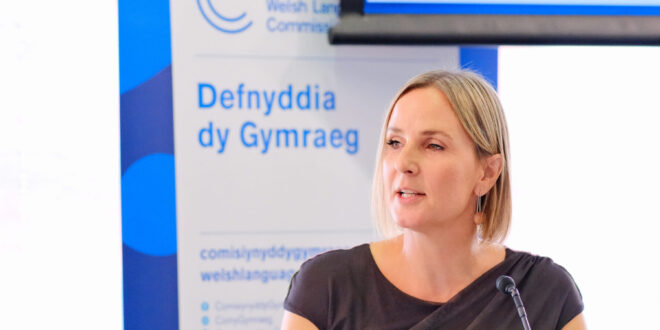
Dr. Eleri James ji Komîserîya Zimanê Galî (Welsh Language Commissioner) ji Infowelatê re qala 33 salên qanûnên ziman li Welatê Galê dike û şîretekê pêşkêşî çalakvanên zimanê kurdî dike: naskirina qanûnî û avakirina kapasîteya pêkanînê divê bi hev re bên meşandin. Hevpeyvîn bi Îngilîzî ye.
Key takeaways
- Law alone does not create speakers. Official status changes the relationship between the state and language users, but people also need skills, confidence and opportunities to use the language.
- From 1993 to 2011. The Welsh Language Act 1993 promised equal treatment but was weakly enforced. The 2011 Measure gave Welsh official status, created the Commissioner and introduced enforceable standards.
- The numbers are sobering. The 2021 Census recorded 538,296 Welsh speakers (17.8%), the lowest percentage ever recorded. The goal of one million speakers by 2050 needs bolder action.
- Teachers come first. Workforce training must start before, or alongside, the expansion of immersion education. Success means learners using the language after school, not just enrolment.
- Advice to Kurdish activists: pursue legal recognition and build the capacity to implement it at the same time. Wales’s model cannot simply be copied, but a language lives through its speakers, so enjoy living through your language.
Interview by Infowelat
How does a language that was once marginalised rebuild official status, create new speakers at scale, and keep those speakers using the language beyond the school gates? Wales offers one of the most closely studied contemporary answers. In this interview, Dr Eleri James of the Welsh Language Commissioner reflects on three decades of language legislation, the ambitious target of one million Welsh speakers by 2050, the strengths and limits of statutory standards, and the hard lessons of workforce planning for immersion education. She argues that legal recognition, education, community planning and workplaces form a single interdependent system. Her final advice to Kurdish language activists is both practical and hopeful: pursue legal recognition and build the capacity to implement it at the same time — and never forget to enjoy living through your language.
From the 1993 Act to the 2011 Measure — Lasting Gains and Limits
Looking back 33 years after the 1993 Act, what do you consider its most lasting contribution, and what were its main limits that the 2011 Measure and the standards system had to address?
The Welsh Language Act 1993 was a landmark. Its most lasting contribution was to establish the principle that, in the conduct of public business and the administration of justice in Wales, Welsh and English should be treated on the basis of equality. It created the Welsh Language Board and required public bodies to prepare Welsh language schemes, moving provision of services in Welsh from goodwill towards organised public administration.
Yet the Act had clear limits. Language schemes differed between organisations, commitments were often unclear, and enforcement was weak. The principle of equal treatment was qualified by what was “appropriate in the circumstances and reasonably practicable.” The Act did not give Welsh official status, create directly enforceable standards, or establish an independent regulator with full investigative powers.
The Welsh Language (Wales) Measure 2011 addressed these weaknesses. It declared that Welsh has official status in Wales, established the Welsh Language Commissioner, and created a system of statutory standards to replace language schemes. Those standards place specific duties on organisations, backed by investigations, enforcement action, appeals and the Welsh Language Tribunal. The change was a shift towards rights, accountability and regulatory clarity. Legislation must, however, remain responsive to changing patterns of service delivery; the Commissioner has called for a review of the standards so they stay relevant to current and future service models.
One Million Speakers by 2050 — How Realistic Is the Target?
In Our time to act you set out priorities for the next five years, with the goal of one million Welsh speakers by 2050. Which priorities do you see as most urgent, and how realistic is the target given recent speaker figures?
The Welsh Government’s long-term target of one million Welsh speakers by 2050 remains both necessary and achievable — but it will not be reached by continuing with existing approaches at their current pace.
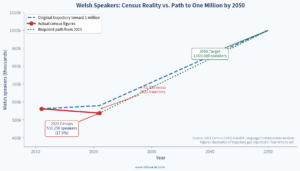
The 2021 Census recorded 538,296 Welsh speakers aged three or over (17.8% of that population). This was 23,720 fewer speakers than in 2011 and the lowest percentage ever recorded. It was also around 41,700 below the original 2021 trajectory towards a million speakers. The trajectory assumes 680,000 speakers by the end of the next Senedd term. That gap means bold and transformative interventions are now required.
The census is a self-assessment exercise conducted during the exceptional circumstances of the COVID-19 pandemic, and other household surveys produce different estimates. Nevertheless, it remains the most comprehensive source, and its message cannot be ignored. The broad picture is, at best, static: the number of speakers has remained comparatively stable over four decades while the population has grown, leaving Welsh in a more vulnerable position.
Three urgent opportunities stand out: creating confident Welsh speakers through the education system; strengthening the use of Welsh in communities; and creating workplaces that support the use of Welsh. Education is fundamental, but increasing the number of pupils who receive some Welsh-language teaching is not enough. Learners must leave school as confident speakers who continue to use Welsh. This requires more Welsh-medium provision and decisive investment in the language skills of teachers, early-years practitioners and the post-16 workforce.
The target is realistic only if it changes present decisions about education, workforce planning, housing, the economy and community infrastructure. It cannot remain an aspiration sitting at the edge of government policy.
Standards, Enforcement and What Works Beyond the Public Sector
The standards now reach some private-sector services, for example banks, telecoms and energy. What have you learned about enforcement and compliance, and what would you advise a community that has no comparable regulator yet?
The Welsh language standards apply to a wide range of public bodies and certain other organisations named in legislation. Banks, telecommunications companies, energy providers and most private-sector businesses are not generally subject to the Commissioner’s enforcement powers. Work with businesses and charities is normally based on support, persuasion and voluntary commitments.
Within the statutory system, clear duties, independent monitoring and credible enforcement make a difference. Compliance is generally highest where responsibility is centrally controlled — for example corporate identity, websites and social media. Progress is uneven, however. Telephone services remain a particular challenge. Publishing a policy or translating a website is not enough; organisations need trained staff, clear internal accountability, effective workforce planning and regular monitoring of the service users actually receive.
Where statutory powers do not apply, the Commissioner’s Hybu team works with businesses and charities to develop voluntary Welsh-language plans. The Cynnig Cymraeg (Welsh Language Offer) gives official recognition to organisations that plan and deliver Welsh-language services successfully. By the end of the reporting period, 169 organisations had received that recognition.
Advice to a language community without a regulator: begin by establishing clear and measurable duties or commitments; reliable evidence about language demand and users’ experiences; an independent body able to monitor progress and report publicly; practical support to help organisations build capacity; direct routes for individuals to raise concerns; and proportionate mechanisms for securing improvement. A regulator’s greatest value is in changing systems and ensuring that language rights do not depend on the goodwill of an individual official. Persuasion, partnership and public recognition remain important while the legal framework is being developed.
Legal Status, Education, Communities and Workplaces — An Integrated Approach
How important is official legal status compared with community language planning, workplaces and education? Where do you see the greatest returns?
It is artificial to separate these elements: they are all essential parts of the jigsaw. Official legal status is essential because it changes the relationship between the state, organisations and language users. It makes clear that using the language is not a favour that may be granted or withdrawn. In Wales, official status, statutory standards and an independent Commissioner provide a foundation for rights, accountability and the provision of services. It is also a bold public declaration of confidence in the language and its relevance to future generations.
Legal status does not by itself create speakers or guarantee that a language will be used. A language can have strong symbolic recognition while continuing to weaken within families, neighbourhoods and everyday social life. Laws can create the conditions for language use, but people need the skills, confidence, opportunities and social networks to use the language naturally.
The strongest returns come from an integrated approach. Education has the greatest capacity to create new speakers at scale, but its long-term effect depends on what happens beyond the school gates. English is increasingly the language of play, entertainment and digital life for many young people, creating a risk that progress achieved through education will remain confined to school. Community language planning is especially important where there is still a high density of speakers, supporting intergenerational transmission. Workplaces can turn language ability into daily practice, strengthen confidence and demonstrate the practical value of the language.
Legal status provides the architecture. Education creates speakers. Communities sustain intergenerational and social use. Workplaces and services give the language contemporary purpose and economic value. Language policy succeeds when those elements reinforce each other.
Building Immersion Education from a Low Base — Lessons for the Workforce
Your manifesto calls for a Welsh-language training framework for the education workforce. What lessons does Wales offer for countries trying to build mother-tongue or immersion education from a very low base?
Ambition for pupils must be matched by investment in the workforce. Schools cannot expand immersion education without sufficient teachers, assistants, leaders, early-years practitioners and specialist staff who can work confidently through the language.
The Welsh Language and Education (Wales) Act 2025 provides a more coherent statutory planning framework: it places the Cymraeg 2050 targets on a statutory basis, provides for a national framework for Welsh-language education, requires school-level delivery planning and creates a stronger chain of accountability. But legislation will not deliver the necessary change unless the workforce has the capacity to implement it. A Welsh-language training framework should form a compulsory part of the training, induction and continuing professional development of every teacher, with much greater investment in the early-years workforce.
Practical lessons for countries beginning from a low base:
- Workforce development must begin before, or at least alongside, the expansion of provision.
- Training needs to be differentiated — from beginner level to the advanced professional language required to teach subjects and manage classrooms — and accompanied by protected learning time and mentoring.
- Immersion support is indispensable for pupils entering the system without the language. Structured immersion can enable pupils who begin with no Welsh to progress to studying subjects through Welsh.
- The system must maintain continuous progression from early years through primary, secondary, vocational and higher education. Breaks in provision lead to loss of skills and confidence.
- Success should not be measured only by enrolment. The real test is whether learners leave education able and willing to use the language confidently in employment, community life and their own families.
Working with Civil Society and Learning from Other Language Communities
How do you work with civil society, language bodies and local authorities, and how important is international cooperation with other minoritised-language communities?
The Commissioner’s functions combine regulation, promotion, research and policy work, so partnership is essential. We work with local authorities, health boards and national parks through statutory standards, including promotion standards. We also work with the Welsh Government, education bodies, public services, businesses, charities and community organisations.
Civil society provides both expertise and linguistic spaces. Organisations such as Mudiad Meithrin, the mentrau iaith, the Urdd, the National Eisteddfod and the National Centre for Learning Welsh have complementary roles in early-years provision, community planning, youth participation, cultural activity and adult learning. Greater investment and stronger collaboration are needed so these organisations can work at the scale required.
International cooperation is extremely valuable. The Welsh Language Commissioner is a founding member of the International Association of Language Commissioners. Minoritised-language communities differ greatly in constitutional position, demography and history, so policies cannot simply be copied. Nevertheless, we face common questions about language transmission, education, digital technology, public services, migration and the relationship between individual rights and collective language vitality. Working with commissioners and language bodies from Basque, Catalan, Irish, Sámi and other contexts allows us to compare evidence, learn from different models of regulation and share practical experience. Reciprocity is essential: Wales has useful experience to share, but it also has much to learn.
Advice to Kurdish Language Activists: Recognition and Capacity Together
If you could offer one piece of advice to Kurdish language activists who are seeking recognition and mother-tongue education, what would it be?
My central advice would be: pursue legal recognition and build the practical capacity for implementation at the same time.
Legal status matters profoundly. It can affirm dignity, create enforceable rights and place responsibilities on governments and public bodies. But recognition without institutions, trained teachers, educational materials and opportunities to use the language may remain symbolic. Conversely, community activity without legal protection can be vulnerable to changes in political will. It is therefore important to connect a clear rights-based case with a practical, long-term strategy.
The Kurdish context is not the same as the Welsh context. Wales’s model cannot simply be transferred. Nevertheless, one lesson from Wales is that progress is most durable when legislation, education, public services, community planning and everyday opportunities to use the language are developed together.
A language lives through its speakers. The ultimate aim should not only be recognition of Kurdish as an abstract principle, but the creation of conditions in which children can acquire it, families can transmit it, adults can use it at work and citizens can receive education and public services through it without disadvantage or fear.
One final and crucial word of advice: enjoy your language and living through your language!